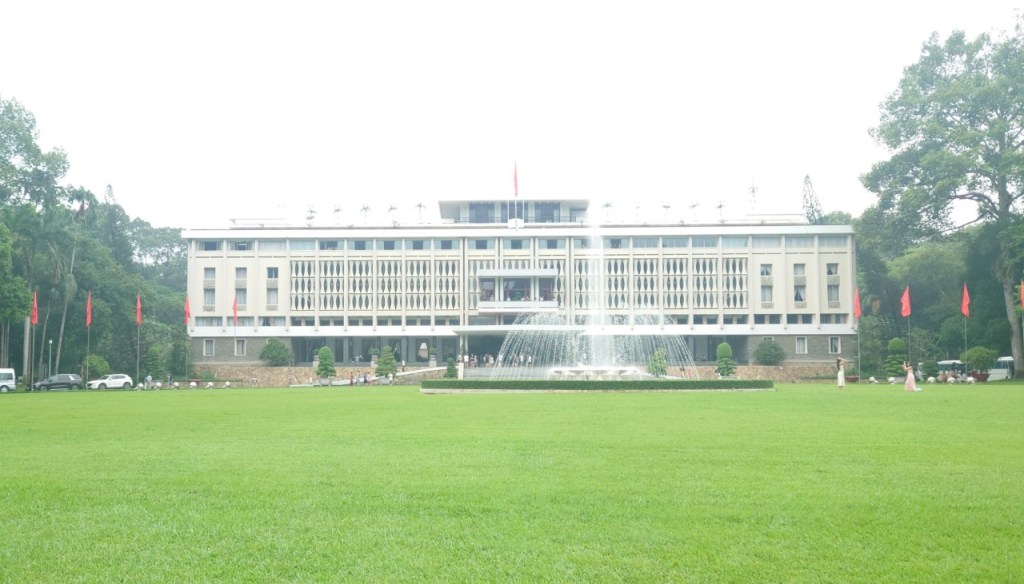
The Independence Place is also publicly known as the Reunification Convention Hall which was recognized as a National Cultural and Historical Relic on Jun 25, 1976.
During the Vietnam War, the Independence Palace served as the residence and office of South Vietnamese President Nguyen Van Thieu. It was designated as a historical monument for having witnessed significant changes in Saigon’s history and keeping the essence of Eastern culture.
The Independence Palace symbolizes Vietnam’s victory, peace, and territorial integrity. This place has a glamorous design, hundreds of rooms equipped with luxurious furnishings and decorations, and an enormous and gorgeous exterior space. It is the perfect place for visitors to get away from the heat, enjoy the fresh cool air and explore one of the most remarkable structures in Ho Chi Minh city.
- Where is the Independence Palace?
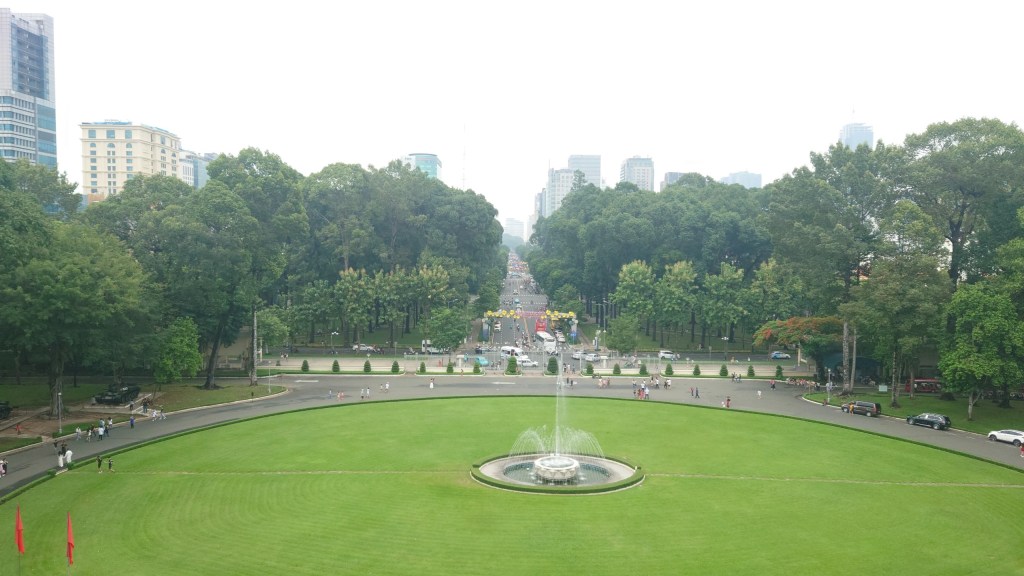
The Palace, a landmark in Ho Chi Minh city, covers 120,000 square meters which is adjacent to four major streets: Nam Ky Khoi Nghia street to the northeast, Huyen Tran Cong Chua street to the southeast, Nguyen Thi Minh Khai street to the northwest, Nguyen Du street to the southeast. It is also adjacent to 30-4 Park at the front and to Tao Dan Cultural Park at the rear. The Palace has many ancient trees, many of which date back to the French period. For those who appreciate art and architecture, this palace is one of the most appealing attractions in our biggest city.
Location: 135, Nam Ky Khoi Nghia Street, Ben Nghe Ward, District 1, Ho Chi Minh.
Opening hours: 8.00AM – 3.00PM (all weekdays and weekends)
2. Independence Palace architecture – a unique and meaningful shape from the outside
Overall, the Palace was designed in the shape “CAT” with the meaning of bringing luck and goodness.
Besides that,
The Palace Center was used as a room for presenting national documents.
The Upper Floor was designed in the shape of the letter “KHAU” to promote freedom of speech and education.
Inside “KHAU”, there was an additional vertical line in the middle (flagpole) to create the letter “TRUNG”, dignified the integrity in democracy.
The four-sided porch roof created a dash to combine with the awning at the entrance of the lobby to the letter “TAM”. The meaning is that people got full capacity of “NHAN” (humanity), “MINH” (Intelligence) and “VO” (Martial Arts) who would help the country prospering. The vertical line connects with the letter “TAM” to form the letter “VUONG” above it there is a flag to create the letter “CHU” with a dotted line.
In front of the 2nd and 3rd floors combines an awning at the main entrance with 2 wooden- covered columns below forming the letter “HUNG”. The architect who designed this Palace also wanted to express the beauty of the Palace in the stone flower curtain which was created from a door from the ancient capital, Hue.
3. History of Independence Palace Vietnam
After the French conquered six provinces in South Vietnam, they built Norodom Palace in 1868 as a residence for Governor- General, which took three years to complete. The French Governor used the palace from 1871 to 1887 and called it the Governor’s Palace. During the Indochina invasion, all Governors – General of French Indochina used the Palace as their residence and working palace from 1887 to 1945.
On March 9, 1945, Japanese forces overthrew the French and took sole control of Indochina. Norodom Palace became the headquarter for Japanese in Vietnam.
In September 1945, with the defeat of the Japanese in the World War II, the French returned to occupy the Southern Vietnam. Once again, Norodom Palace was made the French regime’s headquarter in Vietnam.
The French were defeated at Dien Bien Phu in May 1954, forcing them to sign the Geneva Agreement and withdraw their troops from Vietnam. The United States entered the fray to occupy the South. As a result, Vietnam was temporarily divided into two regions: the North, led by the Democratic Republic of Vietnam, the South, led by the newly proclaimed Republic of Vietnam, led by Ngo Dinh Diem and funded by America. The Norodom Palace was also rename Independence Palace and became Ngo Dinh Diem ‘s office and residence.

The car was of Ngo Dinh Diem
A rebellious bombing in February 1962 irreparably damaged the palace, and as a result, Ngo Dinh Diem ordered that a new one be built. Construction began in 1962 according to the design of the Vietnamese architect Ngo Viet Thu. But Ngo Dinh Diem did not have a chance to see it because he and his brother were assassinated in 1963 before the palace was completed in 1966. The new Independence Palace then served as Nguyen Van Thieu’s home and workplace from 1967 to 1975.
On Apr 30th 1975, two North Vietnamese Army tanks crashes down the walls of the Independence Palace, resulting in the Republic’s fall in Vietnam, the end of Vietnam War, and the reunification of the entire country.
Nowadays, this destination is still known by two names in Vietnam: the Independence Palace and the Reunification Palace and it has became a must-go destination of travelers when they visit Ho Chi Minh city.

 Let's explore Vietnam with Donna